
Silhouettes swept Regency England like a shadow across a candlelit ballroom—simple, affordable, and irresistibly elegant. Before photography stole the spotlight, these stark profile portraits captured a person’s essence in one swift outline, becoming must-have mementos for families from grand estates to modest parlours. Let’s uncover why they captivated an era obsessed with likenesses, legacy, and a touch of artistry.
Affordability
Formal oil paintings demanded hours of sittings and hefty purses, but silhouettes? Mere minutes and pennies.
- Traveling artists wielded scissors or pencils at fairs, Bath assemblies, and Brighton promenades, churning out profiles for anyone—gentry or rising middle class—who craved a personal token.
- Devices like the physionotrace mechanically traced shadows against a screen, ensuring accuracy while keeping costs low, much like Marianne Dashwood’s grid-lined sketch of Willoughby in Sense and Sensibility.
- This democratic appeal made silhouettes the “poor man’s portrait,” preserving family histories without bankrupting the sitter.
Speed and simplicity
No need for elaborate studios—just light, paper, and skill.
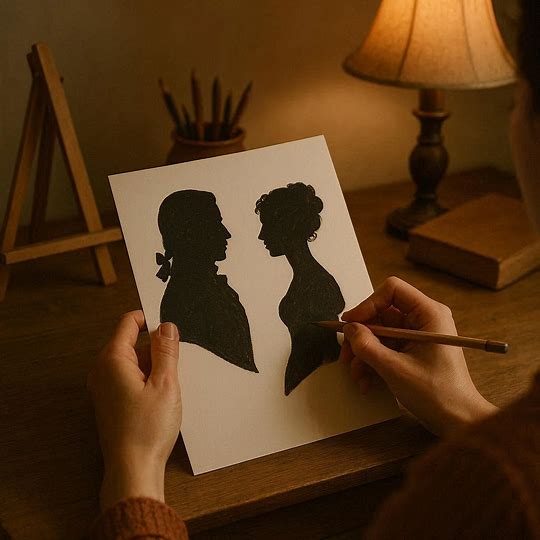
- Artists positioned subjects sideways before a backlight, tracing the shadow’s edge freehand or with tools, then cutting or painting it black against white (or vice versa).
- A full profile emerged in moments, capturing hairstyles, ruffs, and Regency high collars with striking precision—perfect for souvenirs from social seasons or seaside holidays.
- Amateurs joined in at home, folding paper for doubles: one for the family album, another as a gift.
Sentiment and Status
Silhouettes carried deep emotional weight in a portrait-starved society.
- They marked milestones—debuts, weddings, or memorials—adorning lockets, brooches, and walls as portable reminders of absent loved ones.
- Regency neoclassicism revived ancient profile arts from Greek vases and Egyptian tombs, lending a timeless, elegant aura that fit the era’s taste for pared-down beauty.
- For the elite, signed works by masters like John Miers (Edinburgh’s silhouette king) doubled as status symbols, housed in albums alongside miniatures.
Types
| Technique | Description | Regency popularity |
|---|---|---|
| Shadow tracing | Candlelight casts profile on screen | Common for amateurs and quick jobs |
| Scissor cutting | Freehand snips from folded paper | Pro artists like Miers excelled |
| Painted shades | Inked outlines on card or ivory | Fancier, often framed versions |
| Physionotrace | Mechanical stylus for exact lines | French import, mid-Regency hit |
Facts
- The term “silhouette” mocks French minister Étienne de Silhouette, a penny-pincher whose cheap profile hobby inspired rivals to dub all shadows after him in the 1750s.
- Jane Austen’s own distinctive profile survives as a silhouette, cut by her sister Cassandra—proof the craze reached literary heights.
- By the 1830s, photography dimmed their star, but Regency folk artists kept snipping at fairs as a nostalgic, budget-friendly thrill.
Silhouettes weren’t just art—they were Regency life’s quicksilver snapshot, blending sentiment, thrift, and classical cool. Next time you spy a stark profile in an antique shop or Austen adaptation, tip your hat to this shadowy superstar of remembrance.
 Susan Walsh - Author